Aviator is a crash game developed by Spribe, a studio founded in August 2018 in Tbilisi, Georgia. The game launched in early 2019 and passed 10 million monthly players by October 2023. It returns 97% of stakes over time (RTP), which leaves a 3% house edge. This article explains which parts of Aviator can be measured with data and which cannot.
Every round shows a plane climbing a multiplier curve that can crash at any moment. Players see a round history strip, live bets and a statistics panel, so the game feels data-rich. Most of that data, however, describes the past without saying anything about the next round. The sections below cover round history, sample size, the 0.97/m probability distribution and variance, with a worked example.
The Mechanism Behind Each Round
Spribe launched Aviator in early 2019, first live on Adjarabet in February 2019. The studio released Aviator 2.0 on 15 August 2019, a version that ran 40% faster and added chat with emojis and the Rain feature.
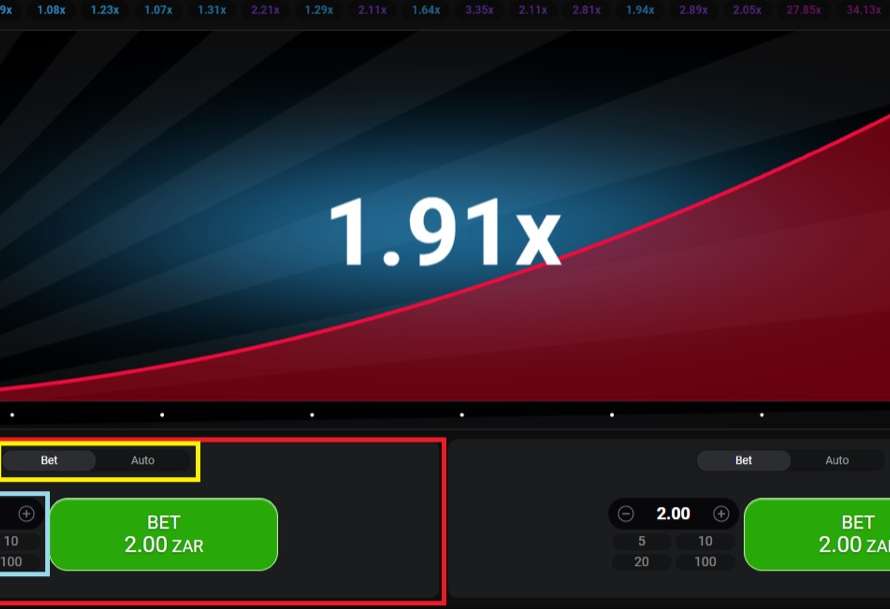
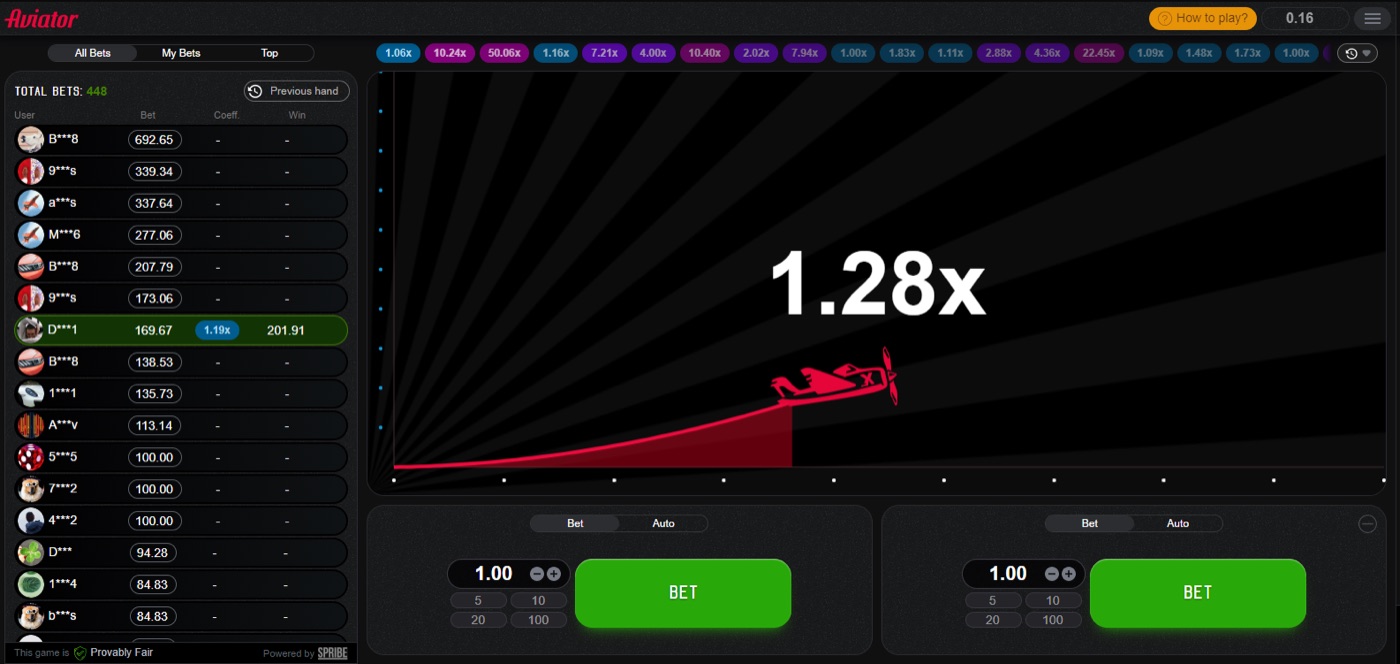
Aviator is not a slot and has no bonus round. A round lasts about 8-30 seconds, with a few seconds between rounds. Before take-off, the crash point is already fixed, so the only live decision is when to cash out. Two bet panels per round allow separate stakes and separate cash-out targets.
- Bet and Auto tabs on each panel
- Auto Cash-Out at a preset multiplier
- Auto Bet / Auto Play for 10-100 rounds with stop-on-win and stop-on-loss
- Round history of previous multipliers at the top of the screen
- In-game chat and a Provably Fair badge
A demo mode exists and needs no registration. The game runs on desktop, tablet and mobile browsers and was built for low bandwidth and budget devices.
Round History and Its Limits
The round history strip sits at the top of the Aviator screen. It lists the multiplier at which each previous round crashed.
The strip is a record of crash points, nothing more. A round that ends at 13.54x still paid a player who cashed out at 1.61x, because each bet settles at its own chosen multiplier. The history shows both events: the crash point of the round and, in the bets panel, what each player actually collected.
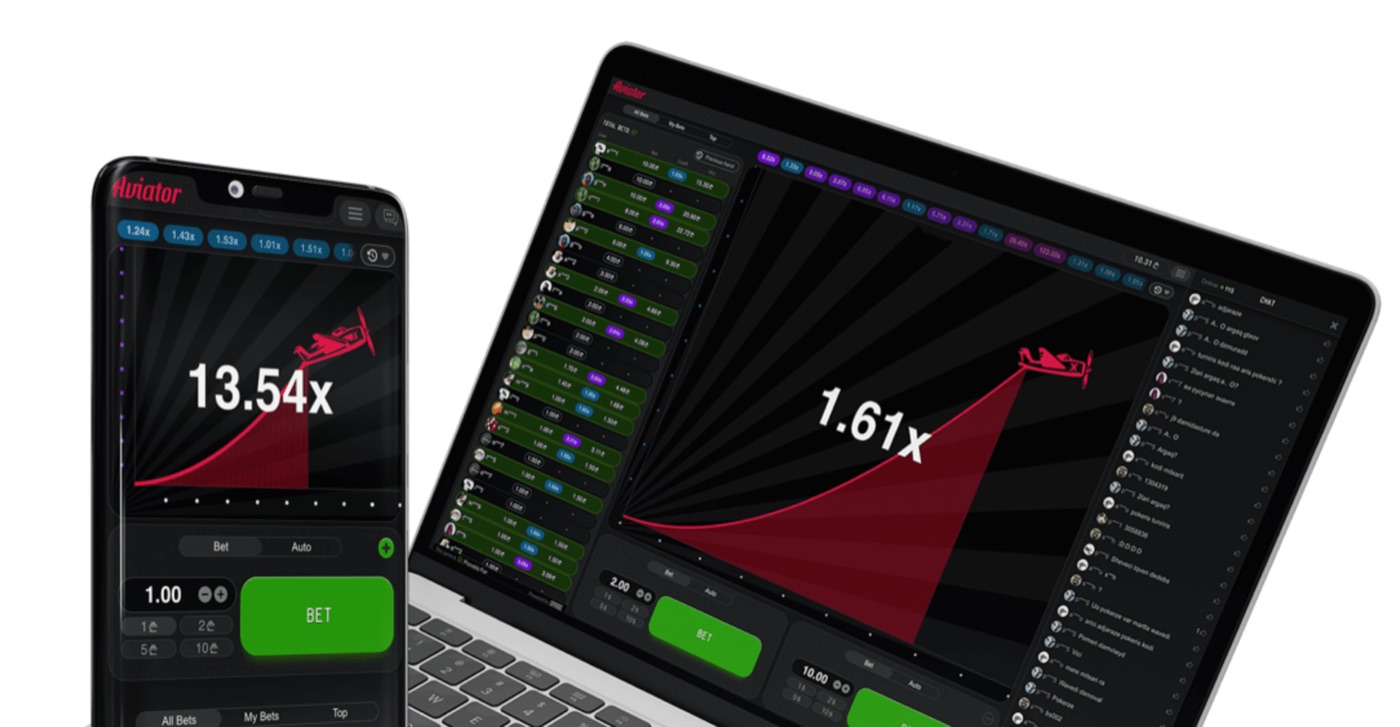
Two devices running the same game; each bet cashes out at its own multiplier, here 13.54x and 1.61x.
The live bets panel adds All Bets, My Bets and a Top tab with daily, monthly and all-time wins. Together with the history strip, this gives a player a large log of past outcomes. That log supports some measurements and blocks others.
- It can show how often low multipliers under 2x appeared in a session
- It can confirm that roughly 1 in 33 rounds crash at 1.00x, but only over a large sample
- It cannot reveal any pattern that predicts the next crash point
- It cannot identify “hot” or “cold” periods, because rounds are independent
The 0.97/m Probability Table
The probability that an Aviator round reaches a multiplier m equals 0.97 divided by m. This single formula reproduces the 97% RTP and fixes the 3% house edge at every cash-out target.
| Multiplier m | Probability of reaching it (0.97/m) |
|---|---|
| 1.2x | 80.8% |
| 1.5x | 64.7% |
| 2x | 48.5% |
| 3x | 32.3% |
| 5x | 19.4% |
| 10x | 9.7% |
| 20x | 4.85% |
| 50x | 1.94% |
| 100x | 0.97% |
About 3% of rounds, roughly 1 in 33, crash instantly at 1.00x. In those rounds no cash-out is possible at any target, which is where the house edge physically enters the game.
A worked example shows the edge. At a 2x cash-out target, the win probability is 48.5% and the payout is 2x the stake: 0.485 × 2 = 0.97. For every 100 units staked, the expected return is 97 units and the expected loss is 3. The same arithmetic holds at every target, so the expected value is -3% of the stake wherever a player cashes out.
- Cashing at 1.5x succeeds in about 64.7% of rounds
- Holding for 10x succeeds in about 9.7% of rounds
- Holding for 50x succeeds in about 1.94% of rounds
- No target in the table has a positive expected value
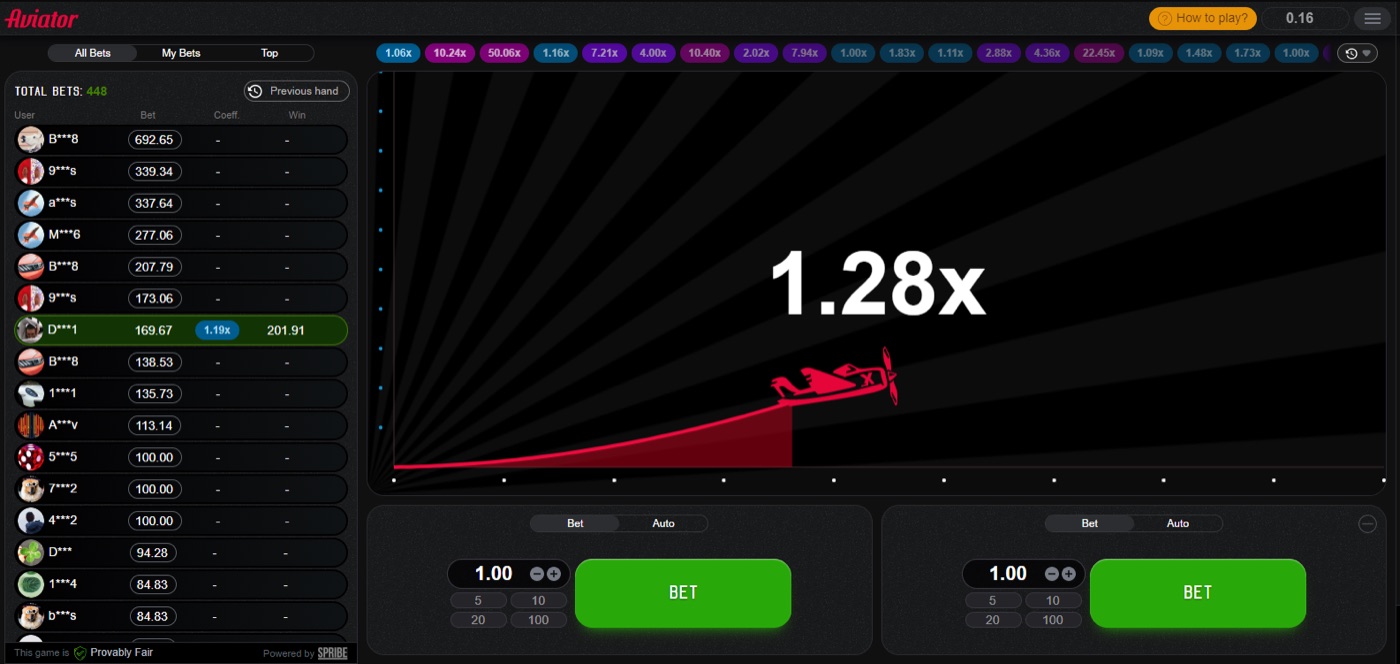
The multiplier climbs during flight; the 0.97/m formula gives the chance of reaching each level.
Sample Size and Variance
Aviator produces 60-90 rounds per hour, so 100 rounds take a little over an hour of play. A sample of 100 rounds is still far too small to confirm the published distribution.
Take the instant-crash rate of 3%. In 100 rounds the expected count of 1.00x crashes is three, but the actual count can easily be zero or six without anything being wrong. To see the 0.97/m curve emerge clearly, a player needs thousands of rounds, which means many hours of observation rather than one evening.
Variance explains why sessions feel different under different targets. Auto cash-out at 1.3x-1.5x wins roughly 65-75% of rounds, producing frequent small returns. A 10x target wins only 9.7% of rounds, so long losing streaks are the normal cost of the bigger payout. Strategy changes variance, not the edge.
That is why no staking plan or aviator game prediction method can raise a crash game’s RTP: the multiplier at which the plane crashes is fixed before the round begins.
- Stake no more than 2% of bankroll per round
- Set loss and win limits before starting
- Test a cash-out target in demo mode first
- Avoid Martingale: doubling after each loss reaches 1,024x the base stake after 10 losses
- Fibonacci and D’Alembert systems also fail to remove the 3% edge
Guides also describe a two-bet split: one bet cashed at 1.5-2x and one left to ride toward 5x-10x. This redistributes variance between the two panels. The expected value remains -3% on each bet separately.
Provably Fair Verification
Before each round, the server publishes a SHA-256 hash of its server seed. Client seeds from players combine with that seed, and together they fix the crash point before take-off.
- The server generates a seed and publishes its SHA-256 hash before the round
- Client seeds from players in the round are combined with it
- The combined input determines the crash multiplier before the plane moves
- After the round, the inputs are revealed
- Anyone can re-run the calculation in the verification tool inside the game
Neither the operator nor Spribe can change a result after the round starts. This is the measurable answer to “rigged” complaints. Reported cash-out time-outs come from latency or a slow device, because the cash-out request must reach the server before the crash.
The same mechanism makes prediction apps impossible. Third-party “Aviator Predictor” apps on app stores and APK mirrors are clones with virtual-coin disclaimers or ads, and Telegram signal bots resell public math. Hollywoodbets tells players not to spend money on Aviator predictors.
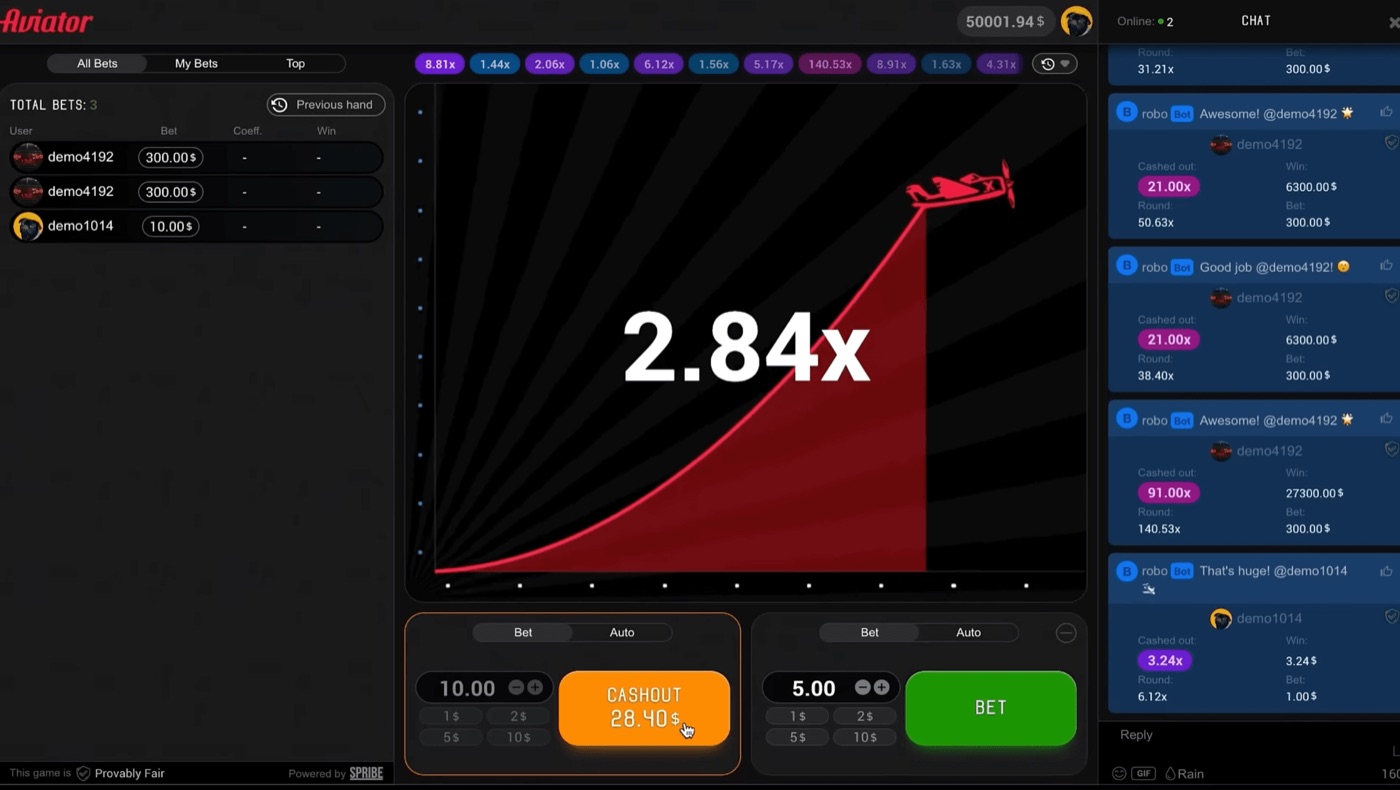
The full interface shows live bets, the chat and each cash-out, such as one at 28.40x.
What the Data Cannot Tell You
Each Aviator round is an independent event. Spribe commits the crash point by hash before the plane takes off, so past results carry no information about future ones.
- “Patterns” in the round history do not change the odds
- “Graph analysis” and “strategy chart PDF” files do not change the odds
- There is no “best time to play”; playing off-peak may smooth the connection, not the odds
- The max multiplier is not published by Spribe, so no table can show the true top end
- Win caps per round are set by each operator, so top payouts depend on the operator
Typical stakes run from about $0.10 up to $100 per bet, but the exact limits depend on the operator. Because the expected value is negative on every bet, treat Aviator as paid entertainment and only stake money you can afford to lose.
Aviator FAQ
Aviator has a published RTP of 97% and a fixed 3% house edge. The answers below repeat the measurable facts without adding new claims.
Can round history predict the next Aviator multiplier?
No. Rounds are independent, and the crash point is fixed by hash before take-off. The history strip describes the past only.
What does the 0.97/m formula mean in practice?
It gives the probability of reaching multiplier m. At 2x the chance is 48.5% and at 10x it is 9.7%. The formula already includes the 3% house edge.
How many rounds make a reliable sample?
Hundreds of rounds are too few. Thousands are needed to see the 0.97/m distribution clearly, and at 60-90 rounds per hour that means many hours of observation.
Is Aviator rigged?
The provably fair system publishes a SHA-256 hash before each round and reveals the inputs afterwards. A verification tool inside the game lets anyone check the result, and neither the operator nor Spribe can alter it after the round starts.
Why did my cash-out time out?
Latency or a slow device delays the request, and the request must reach the server before the crash. Aviator 2.0 was built lighter for slow connections and low-end phones.
Can I test a strategy for free?
Yes. A demo mode exists and needs no registration, so auto cash-out targets and the two-bet split can be tested without staking money.